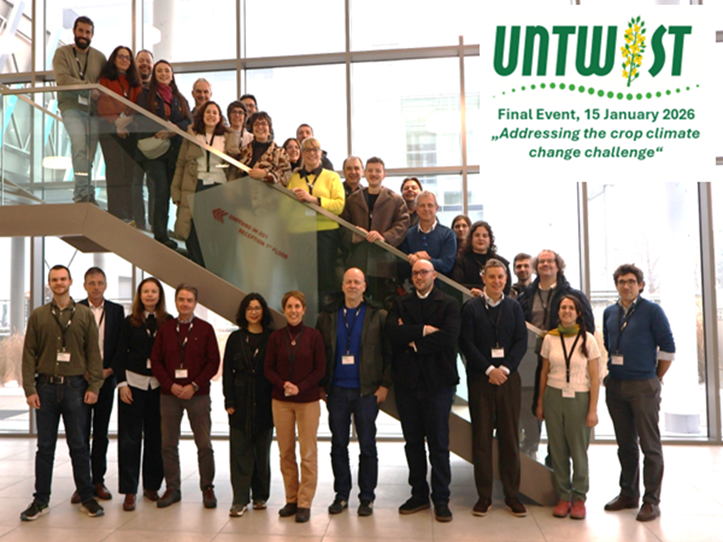
The UNTWIST Final Event, “Addressing the Crop Climate Change Challenge”, held on 15 January, featured research on crop responses to variable and extreme climates, followed by an expert roundtable on “The Future of Minor Crops in the Context of Climate Change”. Around 100 participants attended on site in Vienna or online.
The first part highlighted UNTWIST’s key findings on the stress tolerance mechanism in the climate-resilient oilseed Camelina sativa. Claudia Jonak (AIT, project coordinator) opened the session by outlining UNTWIST´s mission to unravel camelina´s mechanisms for adapting to extreme conditions, followed by a talk by Richard Haslam (Rothamsted Research) on camelina´s remarkable phenotypic plasticity and unique fatty acid signatures that can serve as stress biomarkers. Shifting to predictive science, Sylvain Prigent (INRAE) showcased how machine learning can use greenhouse metabolic data to forecast field performance. Federica Zanetti (University of Bologna) shared optimized management strategies for camelina to maximize yields across European climates. Björn Usadel (FZJ) presented the Plant Adaptation Hub, a digital “one-stop shop” offering the global research community access to UNTWIST and other public resources (e.g., genomic and phenotypic data), standardized agronomic protocols as well as interactive analysis tools.
Talks from two linked projects complemented the UNTWIST presentations. Massimiliano Corso (INRAE) shifted the focus to the seed level, showing that environmental factors induce significant metabolic plasticity in camelina. Finally, Markus Teige (University of Vienna) shared insights from the ADAPT project on the responses of potatoes to adverse environments.
The second session featured a lively roundtable on “The Future of Minor Crops in a Changing Climate,” moderated by Natascha Miljković. Experts from research, industry and agriculture – including Cedric Dufour (Saipol), Barbara Edler (European Minor Uses Coordination Facility), Dominik Klauser (Sustainable Agriculture ISC, Carlsberg Group), Mathias Raab (Raab Oil Mill), Franz Tiefenbacher (Waldland), and Sylvia Vogl (AGES) – discussed strategies to promote the agricultural and industrial development minor crops like camelina.
Panellists emphasized that, to promote minor crops, scientific innovation must be demand-led, with breeding efforts aligned to industrial requirements to ensure consistent performance and specific traits, including targeted oil or protein content. To become economically viable, minor crops also need substantial improvements in yield. Equally important are robust support systems for farmers, such as reliable access to high-quality seed and comprehensive agronomic guidance. Market integration emerged as a decisive factor, with clear demand signals and strong public–private partnerships playing a pivotal role in building new value chains.
The discussion concluded that while climate change calls for greater agricultural diversity, the widespread adoption of minor crops ultimately depends on economic stability for producers and strong connections between research and industry.
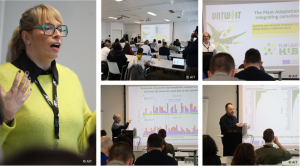
Photo credit: (AIT) UNTWIST partners presenting the key project results at the UNTWIST Final Event.
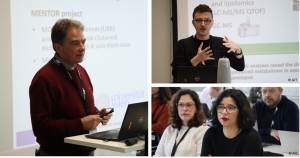
Photo credit: (AIT) Intensive discussions between coordinators of linked projects
ADAPT (Markus Teige, left) and Germoleopro (Massimilano Corso, top – right) with UNTWIST partners.
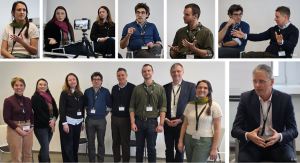
Photo credit: (AIT) Impressions from the round table discussion on the Future of Minor Crops in a Changing Climate.
Claudia Jonak (AIT, UNTWIST coordinator), Natascha Miljković (Moderator), Barbara Edler (European Minor Uses Coordination Facility),
Cedric Dufour (Saipol), Dominik Klauser (Sustainable Agriculture ISC, Carlsberg Group), Mathias Raab (Raab Oil Mill), Franz Tiefenbacher (Waldland), and Sylvia Vogl (AGES).
This final event reflects the hard work, commitment, and collective success of every organization in the consortium, with INI leading communication and results dissemination, and RTDS supporting coordination and exploitation activities, both playing a key role as project partners in the success of the event.