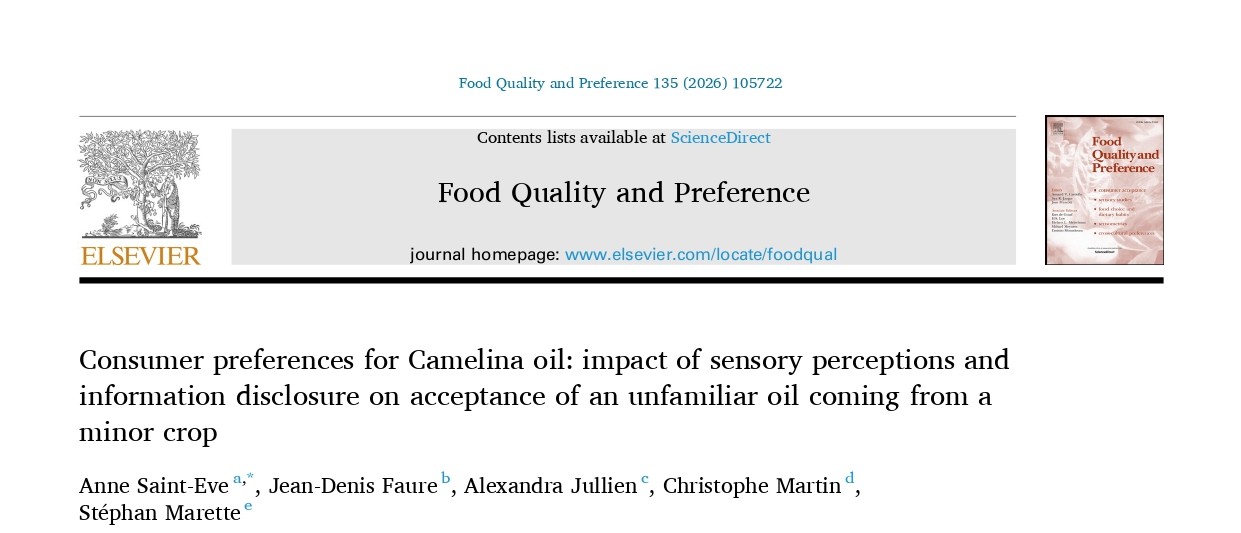
The UNTWIST project is proud to announce the publication of a new research article:
This study investigates how French consumers perceive camelina oil, a traditional but relatively unknown oil derived from a minor crop. Researchers explored both taste preferences and willingness to pay (WTP) through a controlled lab experiment involving 132 participants in Dijon, France.
The experiment was conducted in two steps. First, participants blind-tasted camelina oil, and a subset also tasted extra virgin olive oil for comparison. In the second step, participants received stepwise information about the product, including its identity, health and environmental benefits, and potential improvements through gene-editing (GE).
Key Findings
- During the blind tasting, 35% of participants disliked camelina oil, while 45% enjoyed it.
- Information disclosure significantly influenced willingness to pay. Identifying camelina oil as organic or highlighting its health and environmental benefits increased consumer interest and willingness to pay.
- Conversely, mentioning gene-editing (GE) reduced willingness to pay for nearly half of participants, even when presented positively. This highlights the importance of addressing consumer concerns about biotechnology when introducing novel foods.
This research emphasizes the critical role of targeted communication in promoting new and sustainable food products. By understanding consumer perceptions and preferences, projects like UNTWIST can better support the adoption of innovative crops and oils in the market. The study also provides valuable insights for stakeholders interested in sustainable food systems, consumer behavior, and product marketing strategies.
A special thanks to the INRAE research team, whose dedication and expertise made this study possible. Their work continues to drive forward the mission of UNTWIST and contributes significantly to advancing sustainable agriculture and food innovation.