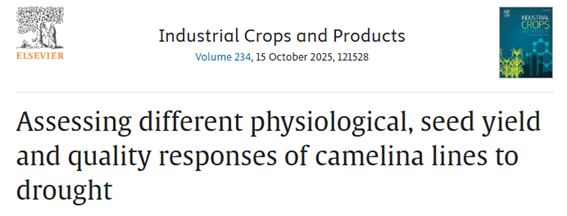
The UNTWIST project is proud to announce the publication of a new peer-reviewed scientific article titled “Assessing different physiological, seed yield and quality responses of camelina lines to drought”, authored by researchers including Barbara Alberghini, Miriana Vicino, Federica Zanetti, Andrea Monti, Walter Zegada-Lizarazu from the University of Bolonia (IT), and Susana Silvestre, Richard Haslam, from Rothamsted Research (UK)
This study focuses on Camelina sativa (L.) Crantz, a highly promising oilseed crop known for its natural drought tolerance. Despite its potential, the variability in drought response among camelina genotypes remains underexplored. The article investigates how four different camelina lines (UNT4, UNT18, UNT21, and UNT46) perform under well-watered and drought conditions, with a focus on early physiological responses and final seed yield.
Key findings include:
-
Some lines, notably UNT46 and UNT21, demonstrated higher seed yield under drought than under favorable conditions.
-
Physiological traits alone did not fully explain drought-related yield differences, highlighting the complexity of stress response mechanisms.
-
Intriguingly, one genotype maintained stable oil content regardless of water availability.
These results provide new insights into camelina’s adaptability and open pathways for breeding more resilient crops capable of maintaining productivity under increasingly frequent drought events.
This research was conducted in the framework of the UNTWIST project, which aims to understand and optimize plant performance under water stress, contributing to a more sustainable and climate-resilient agricultural future.
We invite you to read the full publication in our library section.
Stay tuned for more scientific outputs and project updates!!!